
ISSUE NO. 1 PART 2: Mission + Vision

Updated: May 9

What Riot + Bloom Is Building
The Gap - What is Needed
Let's start with some good news. The digital era has made information easier to find than at any point in history, making digital mental health resources and services more accessible and possible to engage with [4].
A lot has happened in the mental health space over the past decade, and that work continues. Awareness has grown, and there is a lot more access to information and services. One of my favourite things about Australian schools, for example, is the weaving in of social-emotional learning and mental health literacy through initiatives such as Be You [8].
And still, the picture is not fantastic. Mental health difficulties remain substantial, particularly among young people. Roughly one in five Australians experiences a mental disorder in any given year, and rates among young women aged 16 to 24 are particularly high [3].
Fewer than half of those affected access professional help, often not for lack of trying [3].
The need is substantial, and the pressure on existing systems is real [25]. Among the people who fall furthest through the cracks, the pattern is consistent: their experiences often sit at intersections that many standard formats struggle to hold.
This includes neurodivergence, trauma, chronic health, cultural diversity, late recognition, family systems, poverty, and other real-life contexts that shape how people understand themselves and access support [2, 5, 6, 14, 15, 16, 18, 21].
The mission of Riot + Bloom Collective is to contribute to closing that gap.
❤️🔥 Riot + Bloom Collective
Riot + Bloom is a trauma-informed, neurodiversity-affirming creative ecosystem for young people and adults that brings together clinical psychology, storytelling, systems, and advocacy.
The foundational premise is simple: Mental health education should be adaptive, and meaningful psychological information and tools should reach people in formats, language and design they can recognise themselves in and return to outside the therapy room.
Once the online shop and resources library launch, the resources library will hold freely accessible psychoeducational handouts and information, while the shop will hold paid products including educational content, reflective tools, workbooks, and digital downloads. Over time, the vision is to expand into physical products such as sensory and self-regulation tools, and merchandise that carries the heart of the work.
Riot + Bloom is, in part, a dedication born out of the teenage rage of not feeling seen, heard and understood by people in authority, especially those many moments I was told I would never amount to anything in life just because I didn't fit into the same box as everyone else. And it is also built from gratitude.
I was fortunate to have amazing people around me throughout my life who saw me, believed in me, supported me along the tougher parts of my journey. Plus coming to Australia gave me opportunities I never thought I'd have back home. It is especially thanks to my community here that I could heal my aching soul and find ways to turn my life around. I am forever grateful for those people and systems that unexpectedly held me along the way.
So, Riot + Bloom is a dedication to giving back to the community, in the hope that this work might do for someone else what others did for me: help them see themselves, and find a space in which they feel at home.
As such, the Collective is built for people of all ages and walks of life, while keeping in mind people whose experiences are often under-represented in mainstream resources, including:
Neurodivergent adults and children.
Late-identified adults still piecing their stories together.
Teenagers in the messy middle.
People carrying trauma, attachment difficulties, or chronic health conditions.
People whose needs do not arrange themselves neatly inside one diagnostic category.
People who have been told, in one way or another, that they are too much and not enough at the same time.
Community, Advocacy, and Charity
Riot + Bloom stands for mental health advocacy, and underneath it all sits a commitment to community, accessibility, and giving back.
Riot + Bloom is a values-led mission, it is not built to be a profit-first business. Every paid product exists so that more work can be created, shared, and made freely accessible where possible.
Specifically, 20% of proceeds from every paid resource, product, and piece of merchandise across Riot + Bloom and Milk + Mischief is directed to charities and foundations the Collective supports, both nationally and locally on the Gold Coast.
The remaining proceeds are reinvested directly into the work, so more resources, guides, stories, tools, and educational materials can be produced without depending on a single person's unpaid labour.
Where a paid release includes a giving contribution, that will be clearly stated, with funds directed toward aligned charities and causes the Collective supports. Check out the Advocacy page on the website to find out who we support.
The first active campaign supports the Vinnies CEO Sleepout on 18 June 2026.
The CEO Sleepout raises funds for people experiencing homelessness across Australia.
This cause is dear to our hearts, as the sense of feeling at home runs quietly through everything Riot + Bloom makes.
🐾 Milk + Mischief
Milk + Mischief is the children, family, and young-at-heart-facing arm of the ecosystem.
The children's story universe, built around Luna, Archie, and their 'hooman' Annabelle, is built for kids and for the grown-ups who support them.
The seed for Milk + Mischief was planted in my childhood and deepened years ago, when my doctoral work brought me deeper into mindful parenting and child mental health research. I noticed how few mental health resources reached families through warmth and story rather than through clinical worksheets [9, 11, 23, 26].
The stories are written with kids in mind, but they are not only for kids. They are also for parents, caregivers, clinicians, educators, and for young people and adults alike who still carry a little wonder, whimsy, and maybe a little mischief inside.
The whimsical stories of Luna and Archie's adventures are designed to create Mindful Moments through stories, and through parent-child activities and exercises included in each psychologically informed storybook.
Mindful Moments are small, meaningful pauses in the day where a child and the grown-up reading with them can connect, slow down, name a feeling, sit with it together, and come out the other side feeling more attuned and connected.
These parent-child moments matter because children develop emotional awareness and regulation through repeated experiences of emotional scaffolding, co-regulation, and attuned caregiving [11, 12, 19, 20]. Stories are one of the gentlest ways into that work, offering shared language, emotional distance, and a safe way to explore big feelings together [1, 10].
Milk + Mischief stories are written to do exactly that. They hold space for big feelings, sensory differences, repair, change, frustration, courage, waiting, trying again, and the small moments where children and the grown-ups who love them meet each other.
Some stories are quieter and more reflective, designed to open conversation around big feelings, sensory differences, change, repair, or trying again. Others are lighter, sillier, more adventure-led, written to make a child laugh and a grown-up exhale. All of them are built to give parents and caregivers a reason to slow down and meet their child in the moment, without needing to struggle to find the right words, a worksheet or a clinical framework to do it.
Milk + Mischief follows the same ecosystem model as Riot + Bloom. The shop will hold children's books, psychologically informed stories combined with workbooks, parent-child resources, digital downloads, and family-facing merchandise as the universe grows. The same giving-back model applies, with 20% of proceeds from eligible paid releases directed to the charities and foundations the Collective supports.
The first stories are beginning to arrive, and the Milk + Mischief universe is still growing.
✍️ Bloom Unfiltered
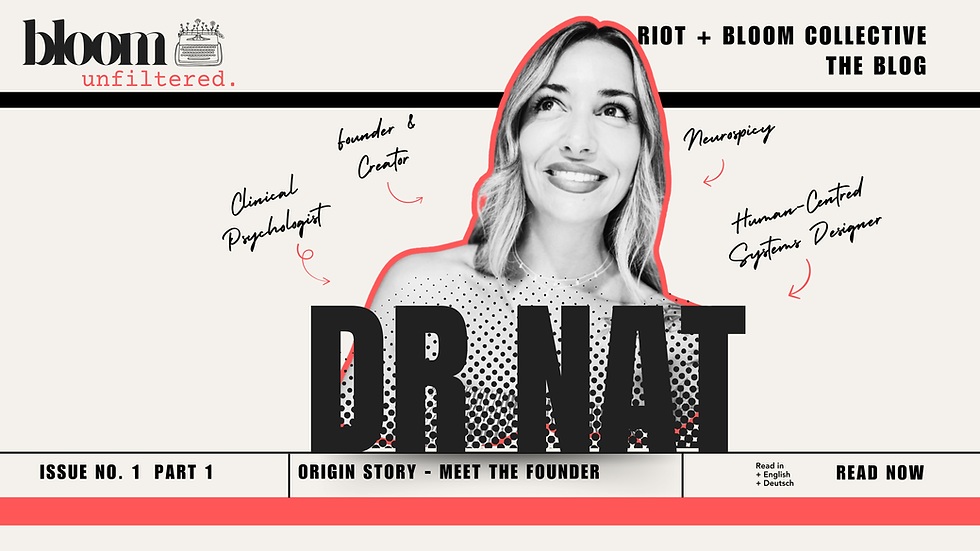
Bloom Unfiltered is the Riot + Bloom blog.
Unfiltered in the sense of a clinician thinking out loud, in real language, without the polish that strips the substance out and creates more barriers for understanding.
The goal is to bridge the format and representation gap in mental health. Some pieces will be reflective. Some will be sharper. None of them will pretend things are simpler than they are.
The blog will comprise short-form and long-form writing on current mental health and psychology topics, with a particular focus on neurodivergence, identity, attachment and relationships, parenting, trauma, living with chronic and complex health conditions, and the parts of being human that do not always make it out of the clinical literature into mainstream and clinical spaces in usable and digestible form.
🧠 CortexBloom
CortexBloom is the systems, design, and digital tools arm of the ecosystem.
CortexBloom started as the scaffolding I was building for my own brain during burnout, and grew once I realised the same scaffolding was something many of my neurodivergent clients described needing. It is in early development and will become more visible as it takes proper shape.
The intention, as it grows, is a thoughtfully curated collection of psychoeducational handouts, more in-depth resources, workbook-style guides for self-reflection, and tools that clinicians might choose to use alongside their own work. With time, this may also include collaborations and partnerships that extend the reach of what one clinician working alone can produce.
A Growing Space: What's Coming
What Riot + Bloom is building is straightforward in concept and slow in practice.
Over time, this will become a layered ecosystem of stories, blog writing, psychoeducational handouts, reflective guides, workbooks, and digital tools. It is being designed with the needs of people with complex mental health, chronic health, neurodivergent, and culturally and linguistically diverse experiences in mind, and written with warmth and clarity so the resources remain genuinely useful and welcoming to everyone else too [14, 15, 16].
Once the online shop and resources library launch, the resources library will hold freely accessible psychoeducational handouts and basic information, while the shop will hold paid resources, tools, stories, workbooks, reflective guides, and merchandise. Over time, the vision is to expand the shop into physical products such as sensory and self-regulation tools.
This is a developing space. It will evolve carefully, with reflection and respect for complexity, and with constructive feedback from likeminded people and professionals who engage with it.
Riot + Bloom will grow with the community that engages with this space. In time, things that have not yet been imagined may emerge through community feedback, lived experience, professional collaboration, and the needs of the people who find their way here.
If you are a colleague, clinician, educator, illustrator, parent, or someone with relevant lived experience, and you find yourself interested in following along, collaborating, reviewing, or contributing as the work takes shape, I would genuinely love that. This work is going to be stronger if it is built with people, not just for them.
If any of this feels like home, the door is open. Subscribe to the newsletter, follow along on socials, or reach out at hello@riotandbloom.com for collaborations or if there is something you want to share.
❤️🔥Together we riot. 🫂 Together we heal. 🌸Together we bloom.
Dr Nat
Dr Natalja Nabinger de Diaz
Founder | Clinical Psychologist
DISCLAIMER: What The Riot + Bloom Space Is Not
Riot + Bloom provides general educational, creative, and reflective content. Stories and resources are for educational and entertainment purposes only. Riot + Bloom does not provide therapy, clinical advice, clinical assessments, or crisis support. My clinical services are provided separately through SANVT Psychology.
If you are in clinical distress, please reach out to a GP, a treating health professional, or a crisis line that can hold you properly.
References and Further Reading
The work of building Riot + Bloom is informed by an ongoing engagement with the empirical, clinical, regulatory, and lived-experience literature on mental health, neurodivergence, child and adolescent development, trauma, accessibility, cultural representation, and ethical practice. The list below reflects key sources that have shaped this piece, along with additional reading for those who want to go deeper.
Aram, D., Fine, Y., & Ziv, M. (2013). Enhancing parent-child shared book reading interactions: Promoting references to the book’s plot and socio-cognitive themes. Early Childhood Research Quarterly, 28(1), 111–122. https://doi.org/10.1016/j.ecresq.2012.03.005
Attoe, D. E., & Climie, E. A. (2023). Miss. Diagnosis: A systematic review of ADHD in adult women. Journal of Attention Disorders, 27(7), 645–657. https://doi.org/10.1177/10870547231161533
Australian Bureau of Statistics. (2023). National Study of Mental Health and Wellbeing, 2020–2022. https://www.abs.gov.au/statistics/health/mental-health/national-study-mental-health-and-wellbeing/latest-release
Australian Government Department of Health, Disability and Ageing. (2025). Digital mental health services. https://www.health.gov.au/our-work/digital-mental-health-services
Australian Government Department of Health, Disability and Ageing. (2025). National Roadmap to Improve the Health and Mental Health of Autistic People 2025–2035. https://www.health.gov.au/resources/publications/national-roadmap-to-improve-the-health-and-mental-health-of-autistic-people-2025-2035
Australian Government Department of Social Services. (2025). National Autism Strategy 2025–2031. https://www.dss.gov.au/national-autism-strategy/resource/national-autism-strategy-2025-2031
Australian Health Practitioner Regulation Agency. (2025). Guidelines for advertising a regulated health service. https://www.ahpra.gov.au/Resources/Advertising-hub/Advertising-guidelines-and-other-guidance.aspx
Be You. (n.d.). National mental health initiative for educators and learning communities. Beyond Blue, headspace, and Early Childhood Australia. https://beyou.edu.au
Bögels, S. M., & Restifo, K. (2014). Mindful parenting: A guide for mental health practitioners. Springer.
Bus, A. G., van IJzendoorn, M. H., & Pellegrini, A. D. (1995). Joint book reading makes for success in learning to read: A meta-analysis on intergenerational transmission of literacy. Review of Educational Research, 65(1), 1–21. https://doi.org/10.3102/00346543065001001
Duncan, L. G., Coatsworth, J. D., & Greenberg, M. T. (2009). A model of mindful parenting: Implications for parent-child relationships and prevention research. Clinical Child and Family Psychology Review, 12(3), 255–270. https://doi.org/10.1007/s10567-009-0046-3
Eisenberg, N., Cumberland, A., & Spinrad, T. L. (1998). Parental socialization of emotion. Psychological Inquiry, 9(4), 241–273. https://doi.org/10.1207/s15327965pli0904_1
Gottman, J. M., Katz, L. F., & Hooven, C. (1996). Parental meta-emotion philosophy and the emotional life of families: Theoretical models and preliminary data. Journal of Family Psychology, 10(3), 243–268. https://doi.org/10.1037/0893-3200.10.3.243
Gray, C., Porter, G., Lobo, R., & Crawford, G. (2024). Development and evaluation of health education resources for culturally and linguistically diverse populations: A systematic review. Health Education Research, 39(2), 102–118. https://doi.org/10.1093/her/cyad015
Healey, P., Stager, M. L., Woodmass, K., Dettlaff, A. J., Vergara, A., Janke, R., & Wells, S. J. (2017). Cultural adaptations to augment health and mental health services: A systematic review. BMC Health Services Research, 17, Article 8. https://doi.org/10.1186/s12913-016-1953-x
Helprin, H., Tamiakis, L., Butler, K., & MacDonald, J. B. (2026). Neurodiversity-affirming practice in community mental health services. Australian Institute of Family Studies. https://aifs.gov.au/resources/practice-guides/neurodiversity-affirming-practice-community-mental-health-services
Lawrence, D., Johnson, S., Hafekost, J., Boterhoven de Haan, K., Sawyer, M., Ainley, J., & Zubrick, S. R. (2015). The mental health of children and adolescents: Report on the second Australian Child and Adolescent Survey of Mental Health and Wellbeing. Australian Government Department of Health.
Micai, M., Fatta, L. M., Gila, L., Caruso, A., Salvitti, T., Fulceri, F., Ciaramella, A., D’Amico, R., Del Giovane, C., Bertelli, M., Romano, G., Schünemann, H. J., & Scattoni, M. L. (2023). Prevalence of co-occurring conditions in children and adults with autism spectrum disorder: A systematic review and meta-analysis. Neuroscience & Biobehavioral Reviews, 155, Article 105436. https://doi.org/10.1016/j.neubiorev.2023.105436
Morris, A. S., Silk, J. S., Steinberg, L., Myers, S. S., & Robinson, L. R. (2007). The role of the family context in the development of emotion regulation. Social Development, 16(2), 361–388. https://doi.org/10.1111/j.1467-9507.2007.00389.x
Paley, B., & Hajal, N. J. (2022). Conceptualizing emotion regulation and coregulation as family-level phenomena. Clinical Child and Family Psychology Review, 25(1), 19–43. https://doi.org/10.1007/s10567-022-00378-4
Pehlivanidis, A., Papanikolaou, K., Mantas, V., Kalantzi, E., Korobili, K., Xenaki, L.-A., Vassiliou, G., & Papageorgiou, C. (2020). Lifetime co-occurring psychiatric disorders in newly diagnosed adults with attention deficit hyperactivity disorder (ADHD) or/and autism spectrum disorder (ASD). BMC Psychiatry, 20, Article 423. https://doi.org/10.1186/s12888-020-02828-1
Psychology Board of Australia. (2025). Code of conduct for psychologists. https://www.psychologyboard.gov.au/Standards-and-Guidelines/Professional-practice-standards/Code-of-conduct.aspx
Shorey, S., & Ng, E. D. (2021). The efficacy of mindful parenting interventions: A systematic review and meta-analysis. International Journal of Nursing Studies, 121, Article 103996. https://doi.org/10.1016/j.ijnurstu.2021.103996
Sroufe, L. A. (2005). Attachment and development: A prospective, longitudinal study from birth to adulthood. Attachment & Human Development, 7(4), 349–367. https://doi.org/10.1080/14616730500365928
World Health Organization. (2022). World mental health report: Transforming mental health for all. https://www.who.int/publications/i/item/9789240049338
Xie, Q.-W., Dai, X., Lyu, R., & Lu, S. (2021). Effects of mindfulness-based parallel-group interventions on family functioning and child and parent mental health: A systematic review and meta-analysis. Mindfulness, 12, 2843–2864. https://doi.org/10.1007/s12671-021-01728-z
Comments