
ISSUE NO. 1 PART 1: ORIGIN STORY.
Updated: May 9
Origin Story: Riot before the Bloom
At eleven, I sat down at our family computer in Germany and started writing a children’s book story. It had a full plot arc. Beginning, middle, end. I knew exactly where it was going.
I never finished it.
Life back then had its own plans, and was tough for my family. So the kids stories got put aside and soon vanished, the way many things did.
I grew up in the German Rhineland-Palatinate, between deep forests and sun-soaked vineyards, cobblestone streets and medieval castles. The landscape carried centuries of stories. My heritage is mixed, with deep German-European and Indigenous South American roots. And nowadays, I also get to call Australia my home.
Growing up between cultures, languages, and worlds, and knowing what it is to not quite fit into any single category, shaped how I think about identity, belonging, and the things people carry that others do not always see.
And honestly, I never wanted to fit the mould anyway. That is part of the story too. And so I was one of those kids who noticed things. Mostly the things adults didn't.
Mental health and life difficulties were threaded through my world from the start: in family, friends, community, and the small weather of daily life. The broader awareness, understanding, representation, or the language to make sense of any of it was thin on the ground. It was truly a wild time to be alive.
I also grew up in a generation that watched the world change quickly and repeatedly: the turn of the century, the internet moving into ordinary homes, rapid technological shifts, global financial instability, terrorism, wars, climate anxiety, pandemics, and the strange experience of watching adults argue about realities that many kids and young adults could already see so clearly unfolding around them.
Those experiences, among others, shaped something in me too. It made me sensitive to systems, to power, to misinformation, and to the way people are often left trying to make sense of huge forces with language that is too small for what they are living through.
Adults around us mislabelled behaviour as laziness or sensitivity or attitude when something else was happening underneath. The kind of help that might have changed things often was not available, or not visible, or not in a form that spoke to what was actually going on.
Living life as a neurospicy kid and young adult in constant survival mode was pretty challenging, to say the least. Managing going through school, independence and often needing to prioritise work at an early age, then uni, more work, life changes, chronic illnesses, and more - it's more than a person can handle - even with the best of tools.
And that's not a complaint, it's just reality and why awareness, understanding, support and accommodations are so important - even for people who may be regarded as extremely high functioning. It ain't easy, ma friend, let me tell ya.
I started looking up things about mental health and discovered psychology online around twelve or thirteen. I decided not long after that I wanted to become a psychologist and learn how to help others who were struggling in ways that felt familiar from my own life, my family, and the people around me.
Whilst life took its turns and detours through a lot of lived experience after that, the decision held. So did the passion for psychology, and the stubborn little hope of leaving the world even just 1% better than how I found it.
Through it all, the innate drive toward creativity, endless curiosity about pretty much everything in life, and the deep want to turn that energy into something positive, something that could maybe even help someone else - that did not disappear. It just did not have much room to breathe for a long time.
Australia. Giving back to my community.
When I came here on a break from university, this place surprised me. There was a cultural openness around mental health I had not encountered before. School psychologists. Accommodations. Conversations that felt like they had room in them.
For the first time in a long long time, I felt accepted - and even appreciated - for my differences.
Parts of me that had been yearning for that kind of awareness, acceptance and belonging began to settle and I found a community, a new home. And so I never left.
How I got here
Perhaps a little context, for those I haven't met.
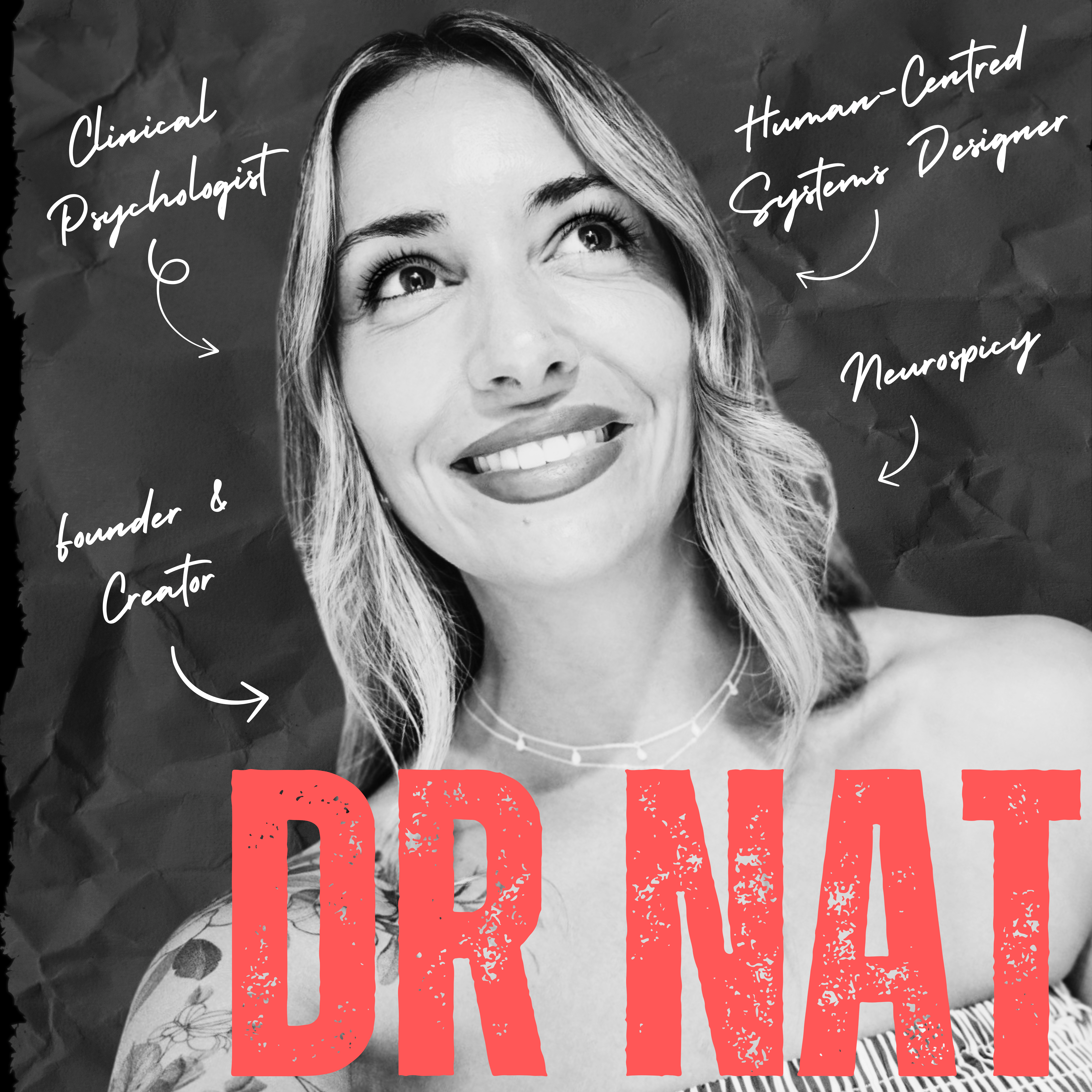
My name is Dr Natalja Nabinger de Diaz, or simply (Dr) Nat and I'm the founder behind Riot + Bloom. I have been a clinician since 2018, working across research, academia, school settings, and private practice.
I'm also a published mental health researcher within the clinical field, and a neurospicy (i.e., neurodivergent) clinician with lived experience. I practice as a registered Clinical Psychologist through my independent practice, SANVT Psychology, on the Gold Coast.
Through my work in clinical research, I had the awesome opportunity to work closely alongside and learn from experts in the field of cognitive behavioural therapy, mindful parenting and child mental health; all of which underpin and shape the work I do [2, 3, 7].
My doctoral research focused on mindful parenting, alongside broader clinical and research work in child and family mental health. Some of that work has been published in peer-reviewed journals, including studies on mindful parenting interventions, parent and child relationships, emotion (co)-regulation, and mindfulness in school settings [2, 3, 7].
Mindfulness mattered to me first because it had transformed my nervous system dysregulation, insomnia and ADHD symptoms in my early twenties, when a Psychologist introduced me to it more formally. I wanted to give back by working toward putting that experience into people's hands earlier, especially young people's. The research turned in a slightly different direction around mindful parenting, but the impulse to support my fellow neurospicy and otherwise troubled people stayed [4, 6, 8].
During recovery from burnout and chronic health flares, I was often forced to slow down and home-bound. As you may not know me, let me tell you - that's not quite something in my nature. I found myself returning to creativity in all its forms, particularly inspired by the adorable natures of my cats.
And somehow I found myself back again - returned to the screen, full of life stories, big and small.
Over years, I kept noticing the same patterns showing up across all of those personal and work settings:
People of all ages with complex, intersecting needs, neurodivergent, trauma-impacted, navigating chronic health, late diagnosed neurospicy individuals, people who were often bright, capable and articulate, were looking for resources, language, and support formats that could hold more of the whole picture. They would often recognise themselves once, in passing, and then lose the thread because the next resource did not speak the same language [1, 5].
The format and lack of representation was often part of the gap [5].
That is where Riot + Bloom began taking shape: not as a neat business idea, and not as a dramatic comeback story, but as the place where creativity, clinical psychology, lived experience, research, storytelling, advocacy, and years of quiet noticing finally had room to meet - and to create a world in which I hope you may find a little piece of yourself.
Riot + Bloom began from the same old impulse to help people make sense of themselves and each other, but it has grown into something wider: a trauma-informed, neurodiversity-affirming creative ecosystem shaped by clinical psychology, lived experience, research, storytelling, advocacy, and a long stretch of quiet noticing [5].
Closing
Somewhere in Germany, more than two decades ago, an eleven-year-old sat down at a computer and started writing a story with a full plot arc. She didn't finish it. Life had other ideas first.
The kid who wrote that children's book story would recognise this work.
About time, she'd say. You're finally home.
_____________________________________
❤️🔥Together we riot. 🫂 Together we heal. 🌸Together we bloom.
______________________________________
Dr Nat
Dr Natalja Nabinger de Diaz (PhD)
Founder | Clinical Psychologist
Riot + Bloom Collective
References and further reading
The work of building Riot + Bloom is informed by an ongoing engagement with the empirical, clinical, regulatory, and lived-experience literature on mental health, neurodivergence, child and adolescent development, trauma, accessibility, cultural representation, and ethical practice. The list below reflects key sources that have shaped this piece, along with additional reading for those who want to go deeper.
Attoe, D. E., & Climie, E. A. (2023). Miss. Diagnosis: A systematic review of ADHD in adult women. Journal of Attention Disorders, 27(7), 645–657. https://doi.org/10.1177/10870547231161533
Emerson, L.-M., Nabinger de Diaz, N., Sherwood, A., Waters, A., & Farrell, L. (2020). Mindfulness interventions in schools: Integrity and feasibility of implementation. International Journal of Behavioral Development, 44(1), 62–75. https://doi.org/10.1177/0165025419866906
Farley, R., de Diaz, N. A. N., Emerson, L. M., Simcock, G., Donovan, C., & Farrell, L. J. (2024). Mindful parenting group intervention for parents of children with anxiety disorders. Child Psychiatry & Human Development, 55, 1342–1353. https://doi.org/10.1007/s10578-023-01492-2
Goyal, M., Singh, S., Sibinga, E. M. S., Gould, N. F., Rowland-Seymour, A., Sharma, R., Berger, Z., Sleicher, D., Maron, D. D., Shihab, H. M., Ranasinghe, P. D., Linn, S., Saha, S., Bass, E. B., & Haythornthwaite, J. A. (2014). Meditation programs for psychological stress and well-being: A systematic review and meta-analysis. JAMA Internal Medicine, 174(3), 357–368. https://doi.org/10.1001/jamainternmed.2013.13018
Helprin, H., Tamiakis, L., Butler, K., & MacDonald, J. B. (2026). Neurodiversity-affirming practice in community mental health services. Australian Institute of Family Studies. https://aifs.gov.au/resources/practice-guides/neurodiversity-affirming-practice-community-mental-health-services
Kabat-Zinn, J. (2003). Mindfulness-based interventions in context: Past, present, and future. Clinical Psychology: Science and Practice, 10(2), 144–156. https://doi.org/10.1093/clipsy.bpg016
Nabinger de Diaz, N. A. (2022). Mindful parenting and parenting stress among parents of young children with anxiety disorders: An examination of theoretical mechanisms, intervention feasibility and response [Doctoral thesis, Griffith University]. Griffith Research Online. https://doi.org/10.25904/1912/4581
Zylowska, L., Ackerman, D. L., Yang, M. H., Futrell, J. L., Horton, N. L., Hale, T. S., Pataki, C., & Smalley, S. L. (2008). Mindfulness meditation training in adults and adolescents with ADHD: A feasibility study. Journal of Attention Disorders, 11(6), 737–746. https://doi.org/10.1177/1087054707308502

Comments